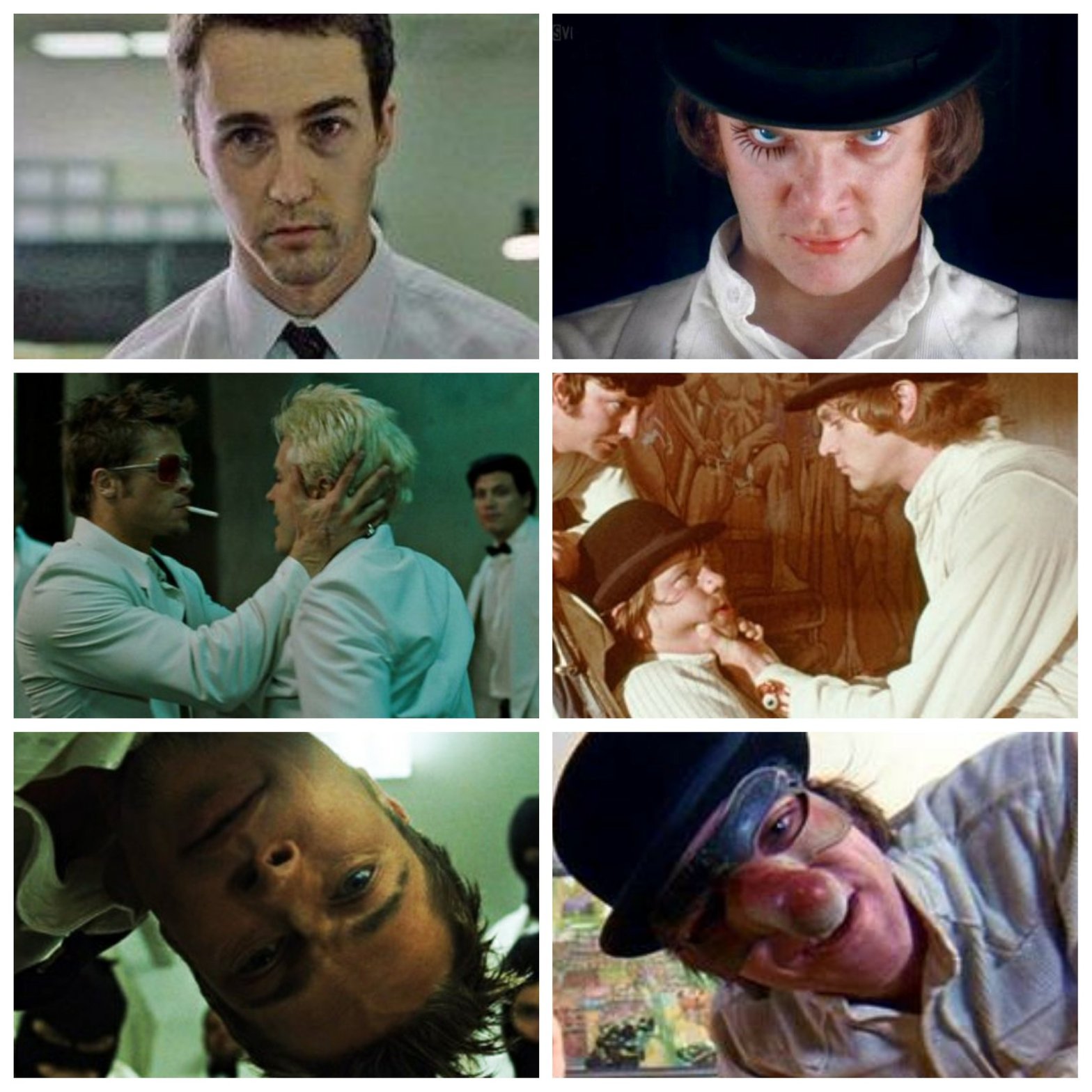
When David Fincher set out to adapt Chuck Palahniuk’s hyper-violent novel FIGHT CLUB, the first and only film that sprang to his mind was Stanley Kubrick’s absurd nod to ultra-toxic masculinity, A CLOCKWORK ORANGE, itself an adaptation of the novel by Anthony Burgess.
The result was a murky counterpart to Kubrick’s film; where CLOCKWORK was bright and overwashed with color, FIGHT CLUB has been run through a mud puddle, where it shines it also blinds, its shadows slither like characters themselves. As the following grid illustrates, not only did Fincher borrow color schemes and character dynamics, but in some instances actual composition meant to illustrate dominance, insanity, and the whisper-thin line between these things and ourselves.
 the flawless frame